Long Term Condition Reviews
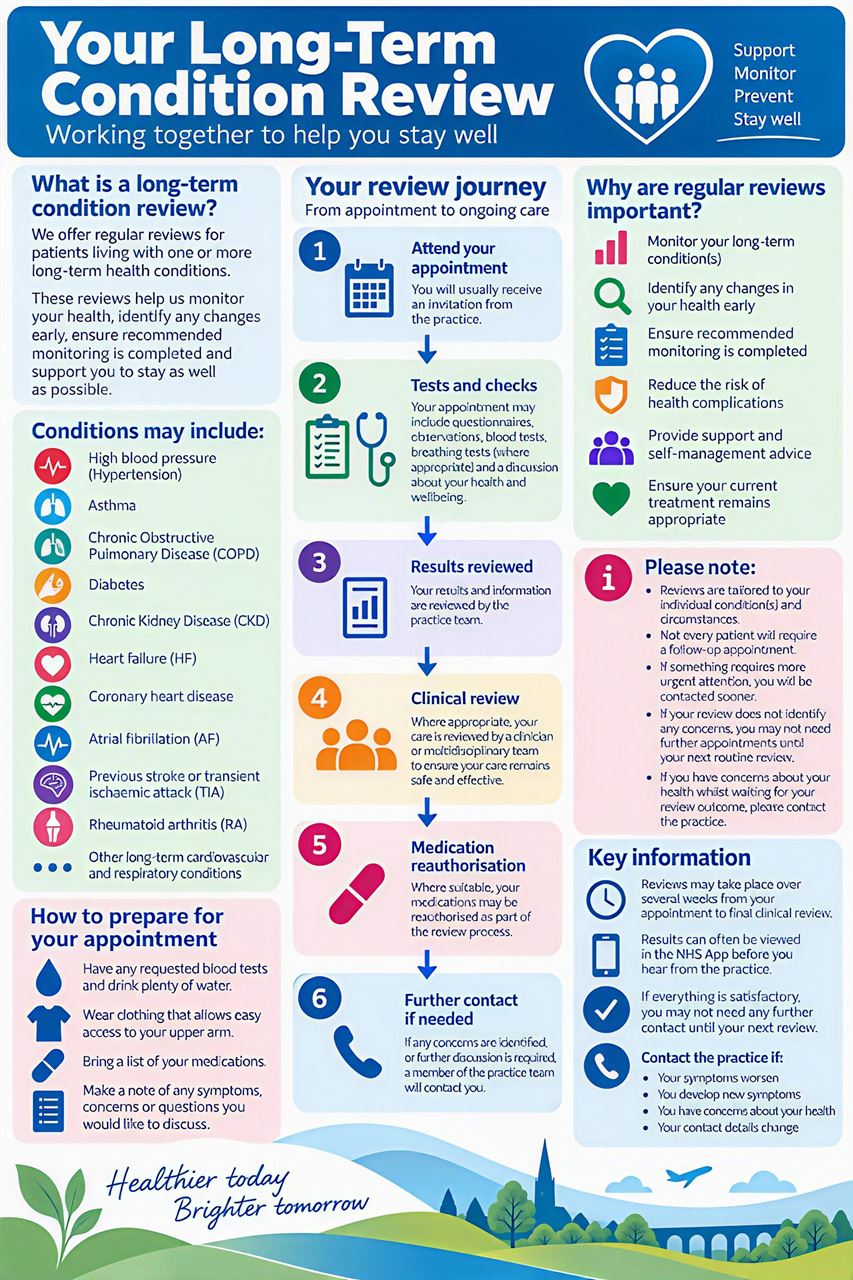
Why are regular reviews important?
Regular reviews help us to:
- Monitor your long-term condition(s).
- Identify any changes in your health at an early stage.
- Ensure that recommended monitoring is completed, especially if you take regular medications.
- Reduce the risk of future health complications.
- Support you to manage your health and wellbeing.
Note - Ordering your medications when you are due a review
Sometimes patients are unable to order their medication through the online system. This is probably because the system has flagged that you are due a review. Please do not worry, we have not stopped your medication but you will need to contact the practice to order them.
We offer regular reviews for patients living with long-term health conditions
To ensure you see the most appropriately trained clinician for you and your medical history, we organise and group certain conditions together and label them. This is mostly an internal process and patients do not often “see” which group they have been assigned. However sometimes, with online appointment booking, patients may see the types of appointments they are being booked into.
This also helps patients understand what appointment they need, and helps staff book the most appropriate appointment for you. A basic overview of the groups can be found at the end.
What happens during the initial LTC appointment?
Your first appointment will usually be with a member of our nursing team. During this appointment they will carry out a range of routine health checks and assessments, which may include:
- Blood pressure measurement
- Height and weight measurements
- Blood tests, where required
- Review of your current symptoms and wellbeing
- Discussion about your long-term condition(s)
- Discussion about how you are managing with any medicines you take, including whether you are experiencing any difficulties, side effects or concerns
This information helps us to monitor your health, identify any concerns and ensure that your treatment and support remain appropriate for your needs.
Please note: The purpose of the LTC appointment is to collect information and carry out routine monitoring. The clinician conducting the appointment will record your observations, results and any concerns you may have. Treatment decisions, medication reauthorisations and any required follow-up are usually considered later by the Long Term Condition (LTC) Multidisciplinary Team (MDT), rather than during the initial appointment itself.
How to prepare for your appointment
To help us make the most of your appointment, please:
- Be prepared to have a blood test if required. Being well hydrated can make blood tests easier, so please drink plenty of water before your appointment.
- If asked to do so, please bring an early morning urine sample with you. Bottles are available at reception.
- Wear clothing that allows easy access to your upper arm, as this can help with blood tests and blood pressure checks.
- Bring a list of any medicines you are taking, including medicines purchased over the counter.
- Be prepared to discuss any symptoms, concerns or changes in your health since your last review.
What happens after my review?
Following your appointment, the information collected will usually be reviewed as part of our Long Term Condition (LTC) Multidisciplinary Team (MDT) meetings. These meetings bring together a GP, pharmacist and nurse to review the results and records of patients who have recently attended for their LTC review.
The MDT will consider your test results, clinical records and any concerns identified during your appointment to ensure that your ongoing care remains appropriate and up to date.
Although MDT meetings take place every working day, a large number of patient reviews are discussed through this process. As a result, it may take several weeks between your initial appointment and any follow-up contact from the practice regarding the outcome of your review.
Please do not be concerned if you do not hear from us immediately after your appointment. This does not necessarily indicate that there is a problem with your results and simply reflects the time required for the MDT review process to be completed.
Blood test results are reviewed by a clinician before they are discussed at the MDT meeting. If any result requires more urgent attention or action, you will be contacted by the practice as soon as possible and will not be asked to wait for the MDT review process to be completed.
If you would like to view your blood test results before your MDT review has taken place, you may be able to do so using the NHS App. If you have concerns about your results or your health whilst awaiting the outcome of your review, please contact the practice.
If your review and test results are satisfactory and no concerns have been identified, you will not normally require any further follow-up appointment. Where repeat medicines or monitoring are due for reauthorisation, these can often be reauthorised as part of the MDT review process, thus eliminating the need for a separate medication review appointment. This helps to ensure that you can continue to request your repeat medication through your chosen ordering method without interruption.
If the MDT identifies any concerns or feels that further assessment is required, additional actions may be arranged. This may include further tests, advice from the practice team, updates to your care plan, or a follow-up appointment with an appropriate clinician.
This approach helps to ensure that patients receive the right level of follow-up based on their individual needs, while avoiding unnecessary appointments where ongoing management can be safely reviewed and agreed by the MDT.
Will I be contacted with my results?
We will usually contact you if your results require discussion or further action.
If all results and reviews are satisfactory, you may not be contacted following the MDT review. Please be assured that all results are reviewed by an appropriately qualified clinician before any decisions are made regarding your care.
You do not need to contact the practice for your results following the review unless you have been advised to do so. A clinician will review all results and we will contact you if any further action is required.
When should I contact the practice?
Please contact the practice if:
- Your symptoms worsen before your appointment.
- You develop new symptoms or concerns.
- You are unable to attend your appointment.
- Your contact details change.
- You need to order medication.
A note about your LTC review
The LTC review process is designed to ensure that patients with stable long-term conditions receive appropriate monitoring, while making best use of NHS resources. By collecting information during your appointment and reviewing it later through our multidisciplinary team process, we can often complete routine monitoring and medication reauthorisations without the need for additional appointments.
Where further assessment or support is needed, a member of the practice team will contact you to discuss the next steps.
LTC Groups Overview
Some conditions are grouped together for internal and organisational purposes.
- LTC - Asthma ( Over 16yrs )
- LTC - Asthma ( Under 16yrs )
- LTC - Asthma ( Over 16 ) – No blood tests required
- LTC - Asthma + COPD
- LTC - Asthma + Diabetes
- LTC - COPD
- LTC - COPD + Diabetes
- LTC - Diabetes
- LTC 10 - Other conditions
LTC10 (Long Term Condition group 10), which includes patients with long-term conditions WITHOUT than Asthma, Diabetes or COPD diagnosis.
Common conditions included within the LTC10 group are;
- High blood pressure (hypertension)
- Chronic kidney disease (CKD)
- Pre-diabetes, gestational diabetes or raised blood glucose levels (hyperglycaemia)
- Heart failure (HF)
- Atrial fibrillation (AF)
- Previous stroke or transient ischaemic attack (TIA)
- Rheumatoid arthritis (RA)
- Other long-term cardiovascular and related conditions
Page created: 19 November 2026